Why Small Businesses Fail at Digital Marketing?
Most small businesses do not fail at digital marketing because they lack social media accounts, websites, advertisements, or content. They fail because these activities are often disconnected from a clear strategy, customer journey, and measurable business outcome.
A business may rank for keywords but generate few qualified leads. Another may spend thousands on Google Ads while sending visitors to a weak landing page. Some businesses publish dozens of blog posts without targeting topics their potential customers actually search for.
The result is the same: marketing activity without predictable growth.
This matters because small businesses are already investing heavily in digital channels. Intuit’s 2025 SMB research found that 96% of surveyed small-business owners and marketing decision-makers planned to advertise, while NFIB reported that 82% of surveyed small businesses had a website.
Simply being online is no longer enough.
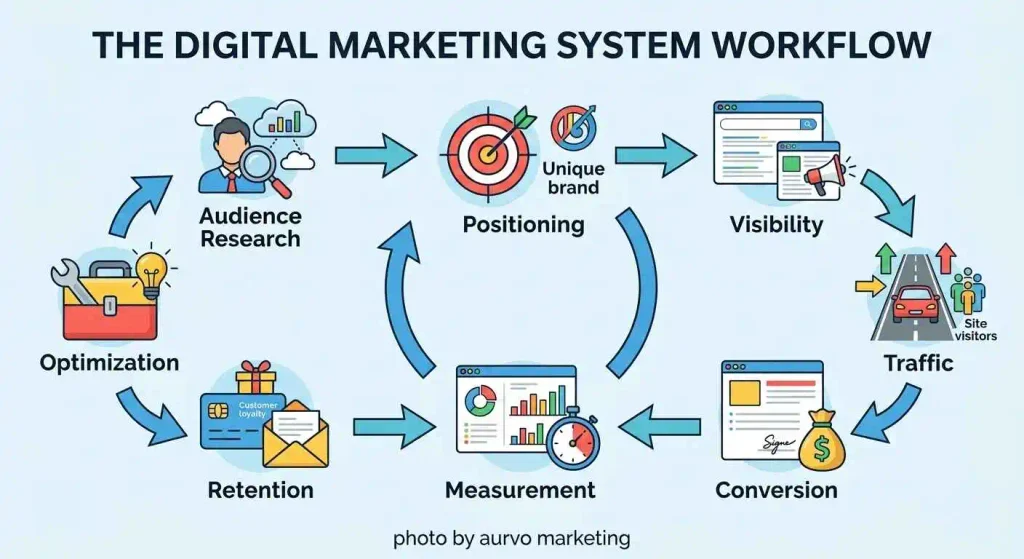
Successful small business digital marketing requires a connected system:
Audience research → positioning → visibility → traffic → conversion → measurement → retention → optimization.
If one part breaks, the entire marketing funnel becomes less efficient.
Here are the most common reasons small businesses fail at digital marketing—and, more importantly, how to fix them.
1. They Start With Marketing Tactics Instead of a Strategy
One of the biggest digital marketing mistakes small businesses make is jumping directly into tactics.
“We need SEO.”
“We should run Facebook Ads.”
“We need to post every day.”
“Our competitor is using TikTok.”
These may be useful channels, but none represents a marketing strategy.
A strong digital marketing strategy begins with four questions:
- Who are we trying to reach?
- What problem are they trying to solve?
- Why should they choose us?
- What measurable action should marketing generate?
The U.S. Small Business Administration recommends evaluating factors such as customer demand, market size, location, pricing, competition, and market saturation before making marketing decisions.
How to Fix It
Create a simple one-page marketing strategy covering:
- Target customer
- Primary customer problem
- Core service or product
- Unique value proposition
- Geographic market
- Primary acquisition channels
- Conversion goal
- Key performance indicators (KPIs)
- Monthly or quarterly targets
Every marketing activity should connect to a business objective.
Instead of saying:
“We want more website traffic.”
Define the goal as:
“We want to generate more qualified consultation requests from local business owners searching for our services.”
The second goal gives SEO, content, advertising, and conversion optimization a clear direction.
2. They Do Not Understand Search Intent or Their Real Audience
Knowing basic demographics is not the same as understanding customers.
A business might describe its audience as “homeowners aged 30–55,” but that tells marketers very little about why those people search, what they fear, what they compare, or what makes them buy.
Effective digital marketing is built around customer intent.
Someone searching:
- “What causes roof leaks?” is researching.
- “Roof repair cost in Dallas” is evaluating options.
- “Emergency roofer near me” may be ready to hire.
These searches require different content and calls to action.
How to Fix It
Build customer profiles using real evidence:
- Sales conversations
- Customer interviews
- Google Search Console queries
- Website analytics
- Reviews
- Support questions
- CRM data
- Competitor research
- Frequently asked questions
Identify:
Pain point → search behavior → desired solution → objection → buying trigger.
Then create content and landing pages around those needs.
This approach improves SEO relevance while making your messaging more useful for traditional search engines, AI-powered search experiences, and real customers.
3. Their Website Looks Good but Does Not Generate Business
A visually attractive website is not automatically an effective marketing website.
NFIB’s 2025 research found that 82% of surveyed small businesses had websites. Having a website, therefore, is increasingly a baseline—not a competitive advantage.
Your website must help visitors quickly understand:
- What you offer
- Who you help
- Where you operate
- Why they should trust you
- What they should do next
Common Website Problems
- Slow loading times
- Poor mobile experience
- Confusing navigation
- Weak service pages
- Generic copy
- Missing trust signals
- Hidden contact information
- Complicated forms
- No clear call to action
- Technical SEO problems
Google also recommends maintaining strong page experience and Core Web Vitals, including targets for loading performance, responsiveness, and visual stability.
How to Fix It
Start with your highest-value pages.
Each important service page should include:
- Clear H1
- Concise service explanation
- Customer problem
- Benefits and outcomes
- Relevant expertise
- Process
- Authentic proof
- Service area where applicable
- FAQs
- Strong CTA
- Relevant internal links
Your website should not function as a digital brochure.
It should function as a customer acquisition asset.
4. They Treat SEO as “Adding Keywords”
Modern SEO is much broader than inserting keywords into headings.
Search engines need to understand your website’s topics, entities, services, relationships, location, expertise, and overall usefulness.
At the same time, users need genuinely helpful information.
Google explicitly recommends creating helpful, reliable, people-first content rather than pages designed primarily to manipulate rankings.
How to Fix Small Business SEO
Build SEO around four areas:
Technical SEO
Make sure important pages can be crawled, indexed, rendered, and used properly.
On-Page SEO
Optimize:
- Search intent
- Titles
- Headings
- URLs
- Content structure
- Images
- Internal links
- Relevant entities and terminology
Content Authority
Create useful resources around the problems customers encounter before, during, and after purchasing.
Off-Page Authority
Earn legitimate mentions, links, reviews, citations, and industry recognition.
Do not obsess over keyword density.
Instead, cover the topic comprehensively using natural semantic language.
For example, an article about small business digital marketing may naturally discuss SEO, paid advertising, lead generation, conversion rates, customer acquisition, analytics, content strategy, local search, and marketing ROI.
That creates topical depth without keyword stuffing.
5. Local Businesses Neglect Local SEO
For plumbers, dentists, lawyers, contractors, restaurants, salons, clinics, and other location-dependent businesses, local search can be one of the most commercially valuable digital channels.
Yet many businesses create a Google Business Profile and rarely touch it again.
Google explains that local results are primarily influenced by relevance, distance, and prominence.
How to Fix Local SEO
Maintain an accurate Google Business Profile with:
- Correct business information
- Appropriate categories
- Accurate opening hours
- Services
- Useful photos
- Website links
- Genuine customer reviews
- Professional review responses
Your website should also reinforce geographic relevance.
Create location pages when they genuinely help customers understand your services in a particular market.
Avoid copying the same text and replacing only the city name.
A consistent page structure is fine, but each location page should contain unique local content, service information, FAQs, proof, and context.
That creates a better experience for users while avoiding thin, repetitive location pages.
6. Their Content Is Generic and Adds Nothing New
Publishing more content does not automatically produce more organic traffic.
Thousands of businesses publish articles such as:
- “5 Benefits of SEO”
- “Why Digital Marketing Is Important”
- “10 Reasons You Need Social Media”
The problem is not necessarily the topic. The problem is that the content often provides nothing readers cannot find elsewhere.
What Authoritative Content Looks Like
Strong content demonstrates:
- First-hand experience
- Subject expertise
- Clear explanations
- Original examples
- Relevant statistics
- Credible sources
- Practical recommendations
- Logical internal linking
- Clear authorship
- Updated information
Google’s people-first content guidance emphasizes original information, substantial coverage, clear sourcing, and content that genuinely helps users accomplish their goals.
How to Fix It
Build topic clusters rather than publishing random articles.
For example:
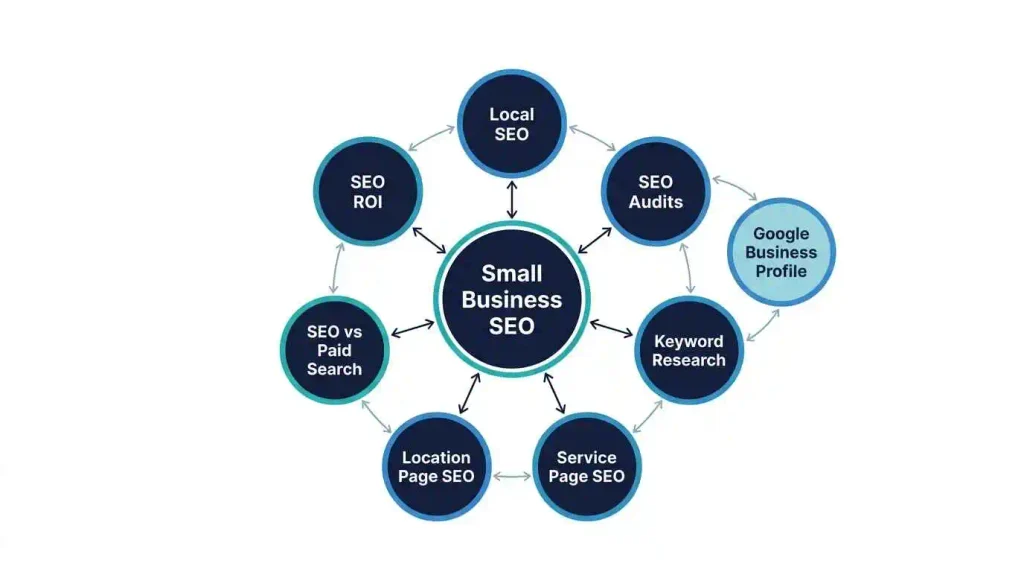
Pillar topic: Small Business SEO
Supporting topics:
- Local SEO for small businesses
- SEO audit checklist
- Google Business Profile optimization
- Local keyword research
- Service page SEO
- Location page SEO
- SEO vs. Google Ads
- How to measure SEO ROI
Connect these pages through contextual internal links.
This helps users explore related questions while strengthening your site’s topical relationships.
7. They Try to Market on Every Platform
Small businesses often assume they need to be everywhere.
Facebook. Instagram. LinkedIn. TikTok. YouTube. Google. Email.
That usually spreads limited budgets and resources too thin.
Pew Research Center’s 2025 research found that U.S. adults use major platforms at different rates, including YouTube, Facebook, Instagram, and TikTok. But popularity alone does not determine whether a platform is right for your business.
How to Fix It
Choose channels based on customer intent and business model.
Use:
- SEO to capture ongoing organic search demand.
- Google Ads to reach high-intent prospects quickly.
- Local SEO for geographically dependent services.
- Social media for awareness, proof, community, and remarketing.
- Email marketing for nurturing and retention.
- Video marketing for demonstrations, education, and trust.
Master a few relevant channels before expanding.
Depth usually beats scattered activity.
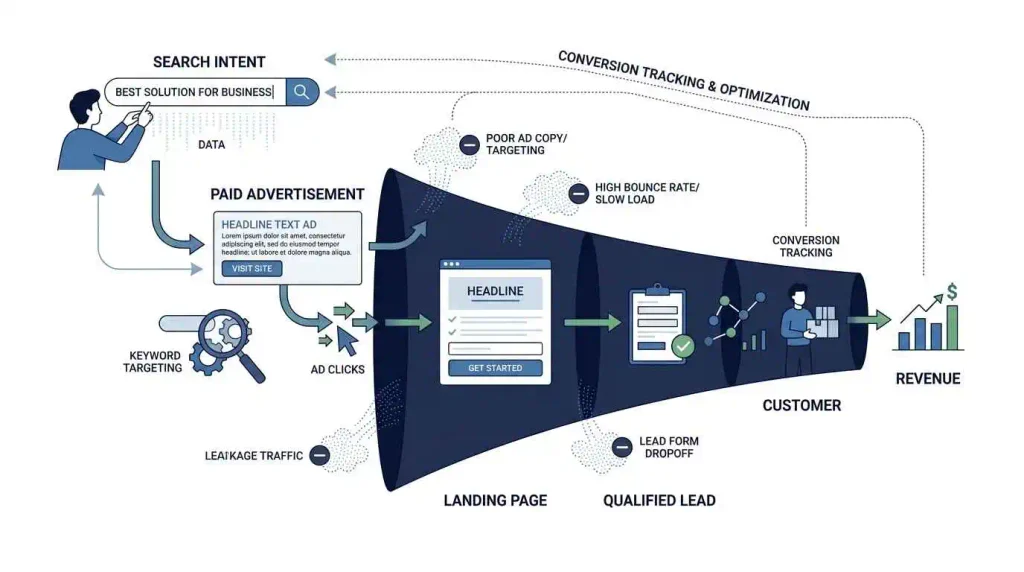
8. They Run Paid Ads Without Fixing the Conversion Funnel
Paid advertising can generate traffic quickly.
It can also waste money quickly.
WordStream’s 2026 search advertising benchmark analysis reported an average $5.42 cost per click and $66.69 cost per lead across its dataset, although actual costs vary significantly by industry and market.
That makes conversion efficiency critical.
Common PPC Mistakes
- Sending ads to the homepage
- Poor keyword targeting
- Weak landing pages
- No negative keywords
- No conversion tracking
- Optimizing for clicks instead of customers
- Changing campaigns constantly
- Ignoring lead quality
How to Fix It
Before scaling paid advertising:
- Define the conversion.
- Calculate acceptable customer acquisition cost.
- Build intent-specific landing pages.
- Configure conversion tracking.
- Separate campaigns by service and intent.
- Monitor search terms.
- Measure qualified leads.
- Connect leads to actual sales where possible.
Paid advertising should amplify a working funnel—not compensate for a broken one.
9. They Focus on Traffic Instead of Conversion Rate Optimization
More traffic is not always the answer.
Imagine two websites:
Website A: 10,000 visitors → 50 leads
Website B: 3,000 visitors → 120 leads
Website B has less traffic but produces significantly more business.
That is why conversion rate optimization (CRO) matters.
How to Improve Conversions
Make sure important landing pages contain:
- Clear value proposition
- Relevant headline
- Visible CTA
- Authentic reviews
- Credentials
- Case studies where appropriate
- Simple forms
- Mobile-friendly contact options
- Objection-handling FAQs
- Transparent next steps
BrightLocal’s 2026 U.S. consumer research found that 97% of respondents read reviews for local businesses, highlighting how strongly reputation can influence the customer journey.
Traffic gets people through the door.
Trust and usability help turn them into customers.
10. They Measure Vanity Metrics Instead of Marketing ROI
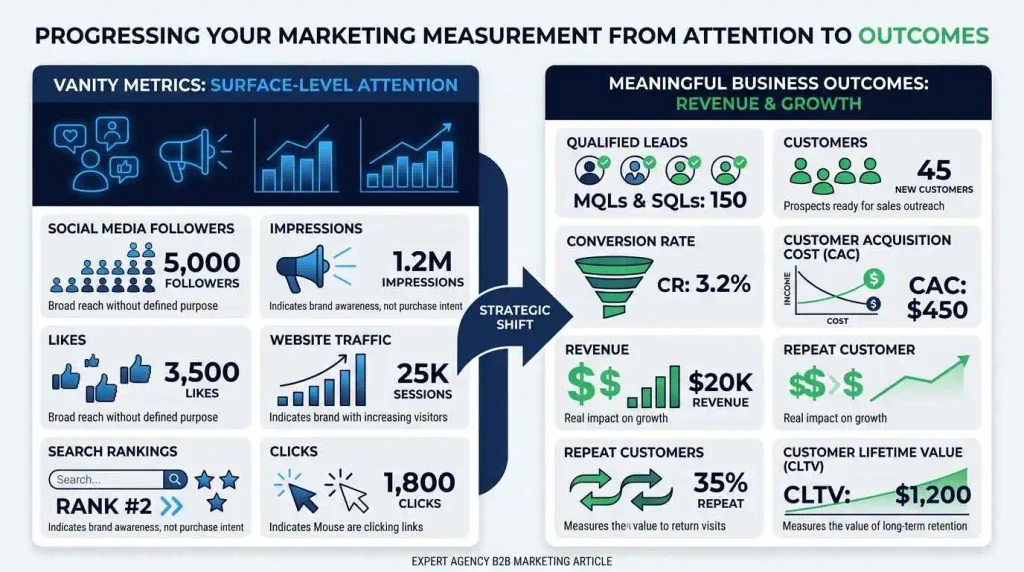
Followers, impressions, rankings, and clicks can be useful diagnostic metrics.
They are not necessarily business outcomes.
A keyword ranking #1 has limited commercial value if it attracts the wrong audience.
A campaign generating 200 leads may still perform poorly if almost none become customers.
What Small Businesses Should Measure
Focus on metrics such as:
- Qualified leads
- Conversion rate
- Cost per qualified lead
- Customer acquisition cost
- Sales conversion rate
- Revenue by channel
- Return on ad spend
- Customer lifetime value
- Repeat purchase rate
- Organic conversions
Use Google Analytics, Search Console, advertising platforms, call tracking, and CRM data to connect marketing activity with customer outcomes.
A results-focused agency should be able to explain:
What happened → why it happened → what it means commercially → what should happen next.
That is far more valuable than sending a dashboard filled with numbers.
11. They Ignore Customer Retention
Many businesses spend most of their marketing budget acquiring new customers while barely communicating with existing ones.
That leaves revenue opportunities on the table.
Digital marketing should cover the entire customer lifecycle:
Awareness → consideration → conversion → onboarding → retention → advocacy.
How to Improve Retention
Use:
- Email follow-ups
- Customer education
- Review requests
- Loyalty programs where appropriate
- Re-engagement campaigns
- Maintenance reminders
- Personalized offers
- Referral programs
- Post-purchase support
Reviews deserve particular attention.
BrightLocal’s 2026 research found that 80% of surveyed consumers said they were likely to use a business that responds to all reviews.
However, reputation management must remain authentic. The FTC prohibits practices involving fake reviews and certain deceptive review incentives.
Build trust rather than manufacturing it.
A Simple 90-Day Digital Marketing Recovery Plan

Days 1–30: Audit
Review:
- Customer segments
- Competitors
- Website
- Technical SEO
- Search Console
- Analytics
- Google Business Profile
- Content
- Paid campaigns
- Conversion tracking
- Reviews
- Lead quality
Identify the three biggest bottlenecks.
Days 31–60: Fix the Foundation
Prioritize:
- Tracking problems
- High-value service pages
- Technical SEO issues
- Mobile usability
- Calls to action
- Local SEO
- Landing pages
- Internal linking
Do not scale traffic until the conversion path works.
Days 61–90: Build and Optimize
Then:
- Publish high-intent content
- Strengthen topical authority
- Test paid campaigns
- Improve landing pages
- Build review processes
- Introduce email follow-up
- Measure qualified leads and revenue
- Scale channels producing meaningful results
Frequently Asked Questions
Why do small businesses fail at digital marketing?
Small businesses commonly struggle because they use disconnected tactics without a clear strategy, target audience, conversion funnel, measurement framework, or consistent execution. Successful digital marketing connects visibility, traffic, conversion, sales, and retention.
What is the biggest digital marketing mistake small businesses make?
One of the biggest mistakes is focusing on marketing activity rather than business outcomes. Traffic, rankings, followers, and clicks matter only when they contribute to qualified leads, customers, revenue, or another defined objective.
Is SEO worth it for small businesses?
SEO can be valuable when potential customers actively search for the products or services a business provides. Effective small business SEO combines technical optimization, useful content, search intent, local visibility where relevant, internal linking, and conversion-focused pages.
Is SEO better than Google Ads?
Neither is universally better. Google Ads can provide faster access to search demand but requires ongoing advertising spend. SEO generally takes longer but can build sustainable organic visibility. Many businesses use both strategically.
How long does digital marketing take to work?
It depends on the channel, competition, website, budget, market, and starting position. Paid advertising can generate data relatively quickly, while SEO and content marketing generally require longer-term execution. Businesses should avoid agencies promising guaranteed rankings or unrealistic timelines.
How should a small business measure digital marketing success?
Measure outcomes closest to revenue: qualified leads, customers, conversion rate, customer acquisition cost, revenue by channel, repeat business, and customer lifetime value. Use traffic and rankings primarily as supporting indicators.
Should a small business hire a digital marketing agency?
An agency can make sense when a business has growth opportunities but lacks the internal expertise, technology, strategy, or execution capacity to pursue them effectively.
Choose an agency that explains its methods, defines measurable KPIs, reports transparently, and focuses on commercial outcomes rather than vanity metrics.
Final Thoughts: Stop Doing More Marketing—Build a Better Marketing System
Small businesses rarely need more random marketing activity.
They need better alignment.
Your audience research should influence your keywords. Your keywords should influence your content. Your content should support your services. Your website should convert relevant visitors. Your analytics should reveal which channels generate qualified customers. And those insights should determine where you invest next.
That is how digital marketing becomes a growth system rather than an expense.
The businesses that succeed are not necessarily the ones posting most frequently, spending the most on ads, or chasing every new platform.
They are the ones that consistently understand their customers, create genuine value, measure meaningful outcomes, and improve what works.
Ready to Turn Digital Marketing Into Measurable Growth?
If your business is investing in SEO, content marketing, local search, Google Ads, or social media but cannot clearly connect that investment to qualified leads and revenue, the problem may not be a lack of marketing.
It may be the system behind it.
Aurvo Marketing takes a results-focused approach to digital growth—examining search visibility, website performance, content, local SEO, paid campaigns, conversion paths, and analytics to identify where opportunities are being lost.
No vanity metrics. No marketing activity simply for the sake of staying busy.
Book a digital marketing consultation with Aurvo Marketing and discover where your current strategy is losing visibility, leads, and growth opportunities.
Leave a Reply