Search has changed quietly. Then all at once.
For years, SEO teams operated inside spreadsheets—sorting keywords by search volume, grouping phrases by exact match similarity, and publishing pages designed around predictable keyword formulas.
It worked because search engines were still heavily dependent on lexical patterns. They read words.
In 2026, search engines read meaning.
Modern algorithms no longer treat language as isolated strings of text. They interpret relationships between concepts, entities, and intent through vector-based semantic understanding. That shift changed everything about how websites earn visibility.
The old workflow looked mechanical:
- Find keywords
- Group variations
- Create pages
- Insert exact-match phrases
- Build backlinks
The modern workflow is architectural.
Today, a successful semantic clustering SEO strategy is about designing an interconnected knowledge ecosystem that demonstrates expertise at scale.
Search engines—and increasingly AI systems—want confidence. They want proof that your site genuinely understands a topic deeply enough to deserve citation in AI Overviews, generative summaries, and high-intent commercial results.
That proof comes from semantic depth.
Not keyword repetition.
Brands still publishing isolated articles around disconnected keywords are slowly becoming invisible in AI-driven search environments.
Meanwhile, brands building entity-focused topical networks are absorbing more impressions, more trust, and more qualified leads without relying on brute-force content volume.
This is the shift from keyword mapping to semantic modeling.
And it is the defining SEO advantage of 2026.
What is Semantic Clustering in the Age of AI?
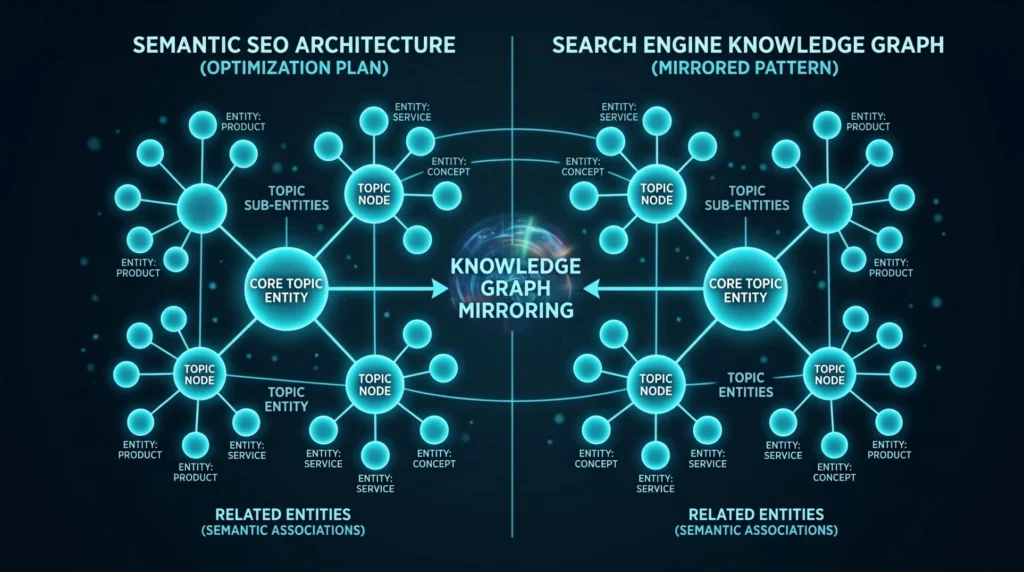
Semantic clustering is the process of organizing content around related concepts, entities, and user intent rather than exact keyword similarity.
That distinction sounds subtle. It is not.
Traditional keyword clustering relied on matching phrases. If two keywords shared similar wording, they were grouped together. The logic was surface-level.
Semantic clustering operates beneath the surface.
It recognizes that users searching for “B2B SaaS pricing strategy,” “subscription revenue models,” and “enterprise software pricing frameworks” may all belong to the same conceptual ecosystem—even if the queries share almost no overlapping words.
Search engines understand that relationship because they no longer depend exclusively on syntax. They depend on semantics.
Strings vs. Things
Google’s evolution toward entity-based SEO fundamentally changed how content relevance is calculated.
Instead of focusing only on strings of words, search systems identify “things”:
- Companies
- Products
- Industries
- Services
- Technologies
- Problems
- Solutions
- Relationships between them
That means your authority is no longer measured by how many times you repeat a phrase. It is measured by how comprehensively you cover an entity and the surrounding concepts connected to it.
For example, a modern semantic cluster around technical SEO might naturally include:
- Crawl budget optimization
- JavaScript rendering
- Log file analysis
- Indexation management
- Core Web Vitals
- Structured data
- Internal linking systems
You do not need exact keyword overlap between every page. The semantic relationship itself creates the cluster.
This is why AI keyword clustering tools powered by NLP models are replacing traditional spreadsheet workflows. They identify conceptual proximity instead of lexical similarity.
The result is cleaner architecture, stronger relevance, and far more resilient rankings.
Vector Embeddings: The Invisible Layer of Modern Search
Underneath modern search systems sits vector mathematics.
It sounds intimidating. It really is not.
Every concept online can be represented as a numerical vector inside multidimensional space. Related ideas exist closer together. Unrelated ideas sit farther apart.
That is how models understand that “technical SEO audit” is semantically related to “enterprise site crawling” even when the wording differs.
These mathematical relationships are called vector embeddings SEO systems.
Google’s neural matching models, transformer architectures, and large language models all rely on embedding-based understanding to interpret content relevance and search intent.
In simple terms:
Search engines now measure meaning, not just matching phrases.
That changes how content should be built.
A page optimized only for exact-match keywords looks shallow to modern systems. A page embedded inside a broader semantic ecosystem appears authoritative because the contextual relationships reinforce each other.
This is why topical authority has become one of the strongest ranking advantages in modern SEO.
Solving Intent Fracture
One of the biggest failures of traditional SEO was intent confusion.
A single keyword often contains multiple user motivations.
Someone searching “technical SEO” could be looking for:
- A definition
- A checklist
- A consultant
- A service provider
- A tool comparison
- A training course
Old SEO strategies tried to force all intent types into one page.
Semantic clustering solves this.
Instead of building one overloaded page, modern architectures separate intent into connected nodes:
- Informational hubs
- Commercial comparison pages
- Transactional service pages
- Educational guides
The cluster becomes an ecosystem designed around user progression.
And that progression matters because search engines increasingly reward sites that satisfy the complete informational journey.
The Anatomy of a High-Performance Cluster
A semantic cluster is not just a collection of articles. It is structured topical infrastructure.
The best-performing clusters usually contain three core components.
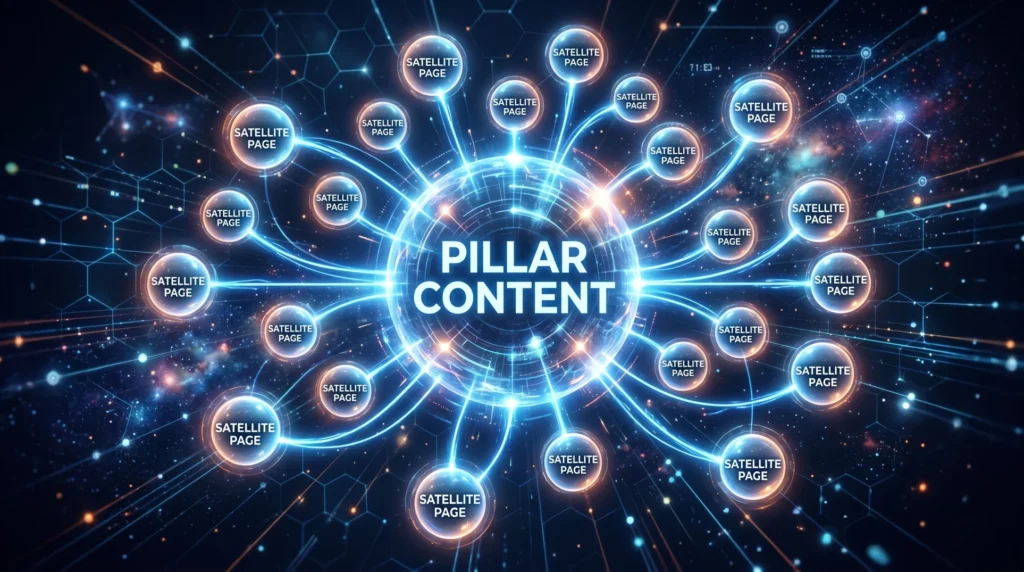
The Pillar Page: The Hub
The pillar page acts as the authoritative overview of the primary entity.
Think of it as the central operating system for the topic.
If your core topic is “B2B Technical SEO,” the pillar page should comprehensively explain the category while introducing all major subtopics connected to it.
It should not attempt to dominate every long-tail query individually.
Its purpose is broader:
- Establish topical breadth
- Define relationships between entities
- Guide users deeper into the ecosystem
- Become the primary relevance source for the cluster
Strong pillar pages feel expansive but controlled. They give users confidence that the site fully understands the topic landscape.
The Spoke Pages: The Nodes
Spoke pages handle specificity.
These are focused, intent-driven pages designed around deeper questions and narrower problems.
Examples include:
- How to Optimize Crawl Budget for Enterprise Sites
- JavaScript SEO Best Practices for SaaS Platforms
- Technical SEO Audits for Large Ecommerce Stores
- Log File Analysis for Indexation Issues
Each spoke strengthens the authority of the broader cluster while capturing highly targeted intent.
This structure also improves conversion quality.
Instead of attracting vague traffic, spoke pages capture users at precise stages of the buyer journey.
A user searching “enterprise crawl budget optimization service” is significantly closer to purchase intent than someone searching “what is technical SEO.”
Clusters help you serve both without confusing either.
The Connective Tissue: Semantic Internal Linking
Internal linking is no longer just navigation.
It is contextual reinforcement.
Modern semantic clustering SEO strategy depends heavily on descriptive internal linking that clarifies topical relationships for both users and crawlers.
This means moving away from robotic anchor text patterns like:
- “best SEO services”
- “technical SEO company”
- “click here for SEO”
Instead, semantic anchors should feel natural and contextually descriptive.
For example:
- “enterprise crawling frameworks”
- “advanced indexation management techniques”
- “site architecture optimization strategies”
These contextual links create semantic pathways that strengthen relevance signals across the cluster.
The goal is not keyword stuffing.
The goal is topical coherence.
Executing a Semantic Clustering SEO Strategy in 2026
Execution matters more than theory.
A modern clustering workflow looks very different from traditional SEO planning.
Step 1: Seed Extraction and Entity Mapping
Start with the core business entity—not a keyword list.
If you are a B2B SaaS SEO agency, your seed entity may include:
- SaaS growth
- Revenue operations
- Product-led acquisition
- Enterprise search visibility
- Customer acquisition funnels
- Technical content systems
Modern NLP and AI-driven tools can map semantic relationships between these entities automatically.
The objective is not discovering keywords.
It is discovering the entire conceptual territory surrounding your expertise.
This creates a far stronger foundation for topical authority 2026 strategies.
Step 2: Intent-Based Grouping
Once entities are mapped, organize them by intent.
The four primary intent layers remain:
- Informational
- Navigational
- Commercial
- Transactional
But in modern SEO, these categories should connect fluidly.
An informational article should naturally guide users toward commercial comparison content. Commercial pages should connect to service pages. Transactional pages should reinforce expertise through educational context.
The ecosystem matters more than isolated rankings.
Step 3: Build the Topical Map
Now structure the architecture visually.
A strong semantic hierarchy makes relationships obvious to users and crawlers alike.
Example:
- domain.com/technical-seo/
- domain.com/technical-seo/crawl-budget/
- domain.com/technical-seo/log-file-analysis/
- domain.com/technical-seo/javascript-rendering/
This creates structural clarity.
Search engines reward clarity because it improves interpretability inside large-scale indexing systems.
A messy architecture creates diluted relevance.
A clean architecture compounds authority.
Step 4: Incorporate Schema Markup
Structured data is no longer optional for competitive SEO environments.
Schema markup helps AI systems explicitly understand:
- Page purpose
- Entity relationships
- Content categories
- Services offered
- FAQs
- Authors
- Organizational expertise
Modern generative engine optimization increasingly depends on machine-readable context.
Schema acts like metadata for AI crawlers.
It reduces ambiguity.
And in AI search environments, reduced ambiguity often translates directly into higher visibility.
Why Semantic Clustering Drives Higher ROI for B2B
B2B SEO is expensive.
High-intent search visibility is even more competitive.
Semantic clustering improves efficiency because it compounds value across the entire ecosystem rather than forcing each page to perform independently.
Eliminating Keyword Cannibalization
Poor site architecture often causes multiple pages to compete for the same query space.
That creates ranking instability.
Clusters solve this by assigning clear intent ownership to each page.
The pillar page owns broad relevance.
Spoke pages own specificity.
Everything reinforces instead of competing.
The result is cleaner indexing and stronger SERP positioning.
Accelerating the Buyer Journey
High-ticket B2B buyers rarely convert after reading one article.
They research extensively.
Semantic clusters allow prospects to self-educate inside your ecosystem without returning to Google repeatedly.
That matters because every return to Google creates competitive exposure.
The longer users stay inside your knowledge network, the stronger your brand authority becomes.
Great clusters reduce friction.
And reduced friction increases trust.
Future-Proofing for GEO
AI-generated search experiences are fundamentally changing traffic distribution.
Search engines increasingly synthesize answers instead of simply listing pages.
That means visibility depends on citation-worthiness.
LLMs prefer pulling information from sites that demonstrate dense topical understanding across connected concepts.
In other words:
Semantic clusters are naturally aligned with how generative systems evaluate authority.
This is why entity-based SEO and semantic modeling are becoming central to GEO strategies.
The future belongs to structured expertise.
Measuring the Impact of Topical Authority
The metrics have changed too.
Tracking one keyword ranking in isolation is becoming less useful every year.
Modern SEO measurement should evaluate ecosystem performance.
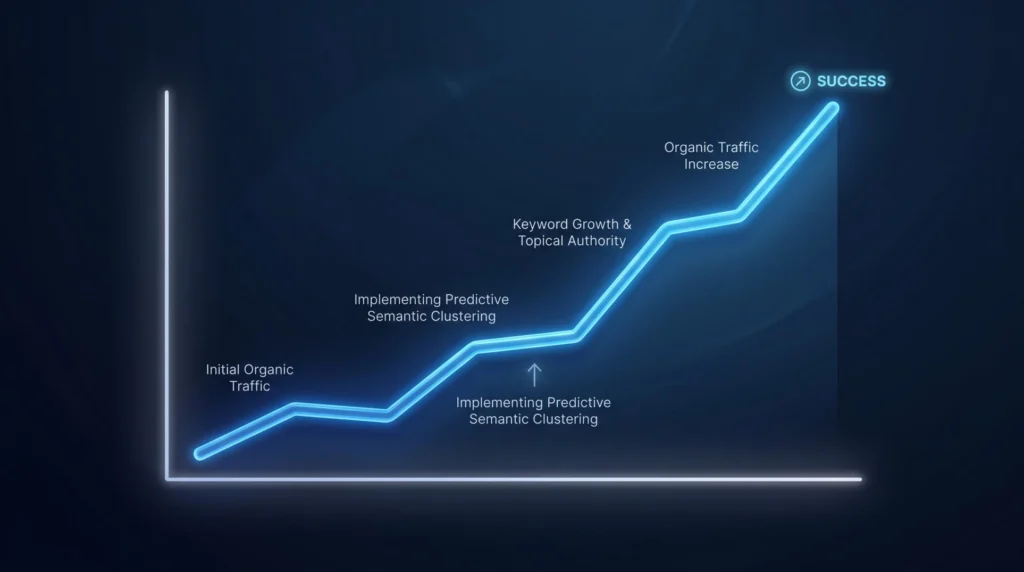
Cluster-Level Impression Growth
Instead of obsessing over one ranking, analyze the total organic visibility generated by the cluster as a whole.
Healthy semantic ecosystems often produce exponential long-tail expansion over time.
One strong cluster can rank for thousands of related queries without direct optimization.
That is the compounding effect of semantic relevance.
Semantic Resonance
One of the clearest signals of true authority is ranking for queries you never intentionally targeted.
If Google begins associating your domain with adjacent concepts automatically, your semantic footprint is expanding.
That is semantic resonance.
And it is one of the strongest indicators that your clustering strategy is working.
Lead Velocity
Traffic means little without business outcomes.
Track how cluster completion affects:
- Demo requests
- Consultation bookings
- Form submissions
- Qualified pipeline growth
The best semantic clusters do not just increase traffic.
They increase trust-qualified traffic.
That difference matters.
Authority Requires Architecture
Semantic clustering is not a content hack.
It is structural engineering for modern search visibility.
The brands winning in AI search environments are not necessarily publishing the most content. They are building the most coherent knowledge systems.
That distinction changes everything.
Disconnected blog posts are becoming obsolete because AI systems struggle to interpret fragmented expertise. Dense semantic ecosystems, however, create unmistakable topical authority.
And authority is the currency of modern search.
In 2026, the websites dominating AI Overviews and generative search experiences will not be the loudest publishers.
They will be the clearest thinkers.
They will build architectures of intent.
And those architectures will become impossible for search engines to ignore.
Rank Higher.
Get More Leads.
Or You Don’t Pay.
Aurvo Marketing helps businesses grow through technical SEO, content strategy, topical authority, and AI-era search optimization.
Organic Traffic
Last 6 Months
Leave a Reply