
Complete Guide: How to Optimize Website for Gemini and ChatGPT Search
Search engines are evolving rapidly. Instead of scrolling through dozens of links, users now ask AI systems direct questions and receive instant answers.
This shift has created a new discipline called Generative Engine Optimization (GEO).
Generative Engine Optimization focuses on optimizing content so AI search engines can extract, summarize, and cite it in their responses.
Unlike traditional SEO, where ranking on search result pages is the main goal, GEO focuses on becoming a trusted source that AI systems reference when generating answers.
In this pillar guide, you will learn:
- What Generative Engine Optimization is
- How AI search engines work
- Key GEO strategies for ranking in AI results
- Content optimization techniques for AI visibility
- Technical SEO foundations for AI crawlers
- Metrics to measure GEO success
If you want your website to stay visible in the future of search, GEO is essential.
Table of Contents
What Is Generative Engine Optimization (GEO)?
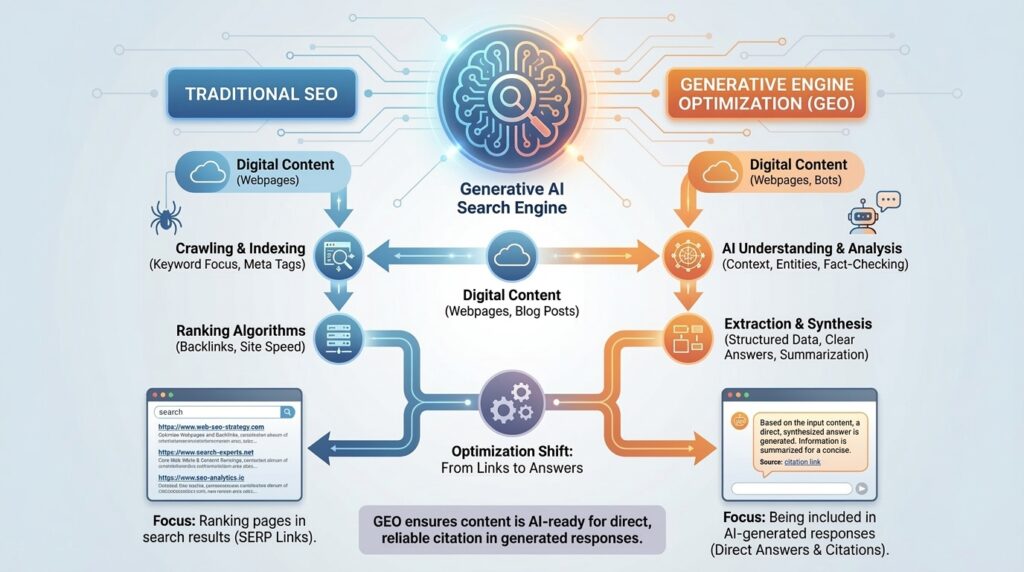
Generative Engine Optimization (GEO) is the process of optimizing digital content so AI-powered search systems can easily understand, extract, and cite it when generating answers.
Traditional SEO focuses on ranking pages in search results.
GEO focuses on being included in AI-generated responses.
Quick Definition
Generative Engine Optimization is a strategy that helps websites become trusted sources for AI search engines and conversational AI tools.
Instead of optimizing only for keywords, GEO focuses on:
- context
- clarity
- factual accuracy
- structured formatting
This makes content easier for AI systems to interpret.
Why Generative Engine Optimization Is Important?
Search behavior is changing quickly.
More users now rely on AI-powered search tools to find information instead of clicking through multiple websites.
This trend is transforming how visibility works online.
Websites that do not adapt to AI search optimization risk losing traffic and authority.
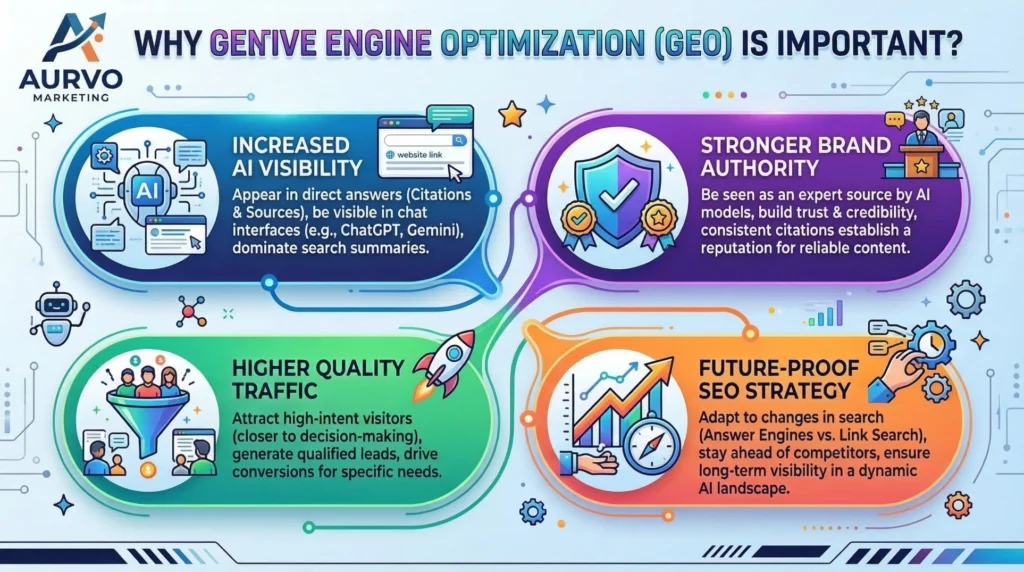
Key Benefits of GEO
Businesses that implement GEO strategies gain several advantages.
Increased AI Visibility
Content optimized for GEO has a higher chance of appearing in AI-generated answers.
Stronger Brand Authority
When AI systems cite your website as a source, it increases credibility.
Higher Quality Traffic
Users who visit your site after seeing it referenced in AI answers already trust the information.
Future-Proof SEO Strategy
As AI search grows, GEO ensures your content remains discoverable.
How AI Search Engines Work
To succeed in Generative Engine Optimization, you must understand how AI search systems generate answers.
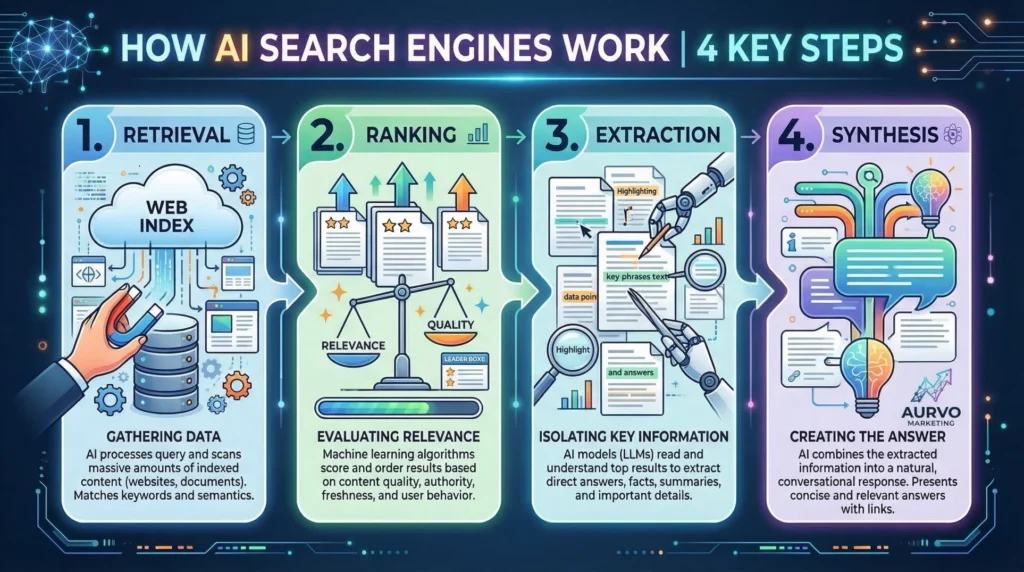
Most AI search engines follow a four-step process.
1. Retrieval
The system first retrieves relevant web pages from its index.
Traditional SEO factors play a major role at this stage, including:
- keyword relevance
- website authority
- indexing status
- backlinks
If your content cannot be found during retrieval, it cannot be used in the final answer.
2. Ranking
After retrieving pages, the AI system ranks them based on relevance and information quality.
Content that performs well usually has:
- clear headings
- strong topical focus
- high information density
- accurate facts
Well-structured pages often rank higher in this stage.
3. Extraction
Next, the AI extracts key information from selected pages.
Content that is easy to scan is more likely to be used.
Examples of AI-friendly formatting include:
- bullet lists
- numbered steps
- comparison tables
- short paragraphs
Long blocks of text reduce extraction efficiency.
4. Synthesis
Finally, the AI combines extracted facts into a coherent answer.
During this step, the system may:
- quote sources
- paraphrase information
- provide citations
Your goal with GEO is to ensure your website becomes one of the sources used in this synthesis process.
Technical SEO Foundations for GEO
Technical SEO is the backbone of Generative Engine Optimization.
Without proper technical optimization, AI crawlers cannot access or interpret your content.
Ensure AI Crawlers Can Access Your Website
Your robots.txt file should allow AI crawlers to access important pages.
Blocking bots may prevent your content from appearing in AI search results.
Important actions include:
- reviewing robots.txt
- allowing major crawlers
- preventing accidental crawl blocks
Proper crawl access ensures your content can be discovered. Here how your robot.txt file look
# Allow all bots and search engines
User-agent: *
Allow: /

# Specifically allow major search engines and AI crawlers
User-agent: Googlebot
Allow: /

User-agent: Bingbot
Allow: /

User-agent: Yandex
Allow: /

User-agent: Baiduspider
Allow: /

User-agent: GPTBot
Allow: /

User-agent: ChatGPT-User
Allow: /

User-agent: ClaudeBot
Allow: /

User-agent: CCBot
Allow: /

User-agent: PerplexityBot
Allow: /

User-agent: OAI-SearchBot
Allow: /

# Standard exclusions for security and performance
Disallow: /wp-admin/
Allow: /wp-admin/admin-ajax.php

# Link to your sitemap to help bots find content faster
Sitemap: https://aurvomarketing.com/sitemap.xml
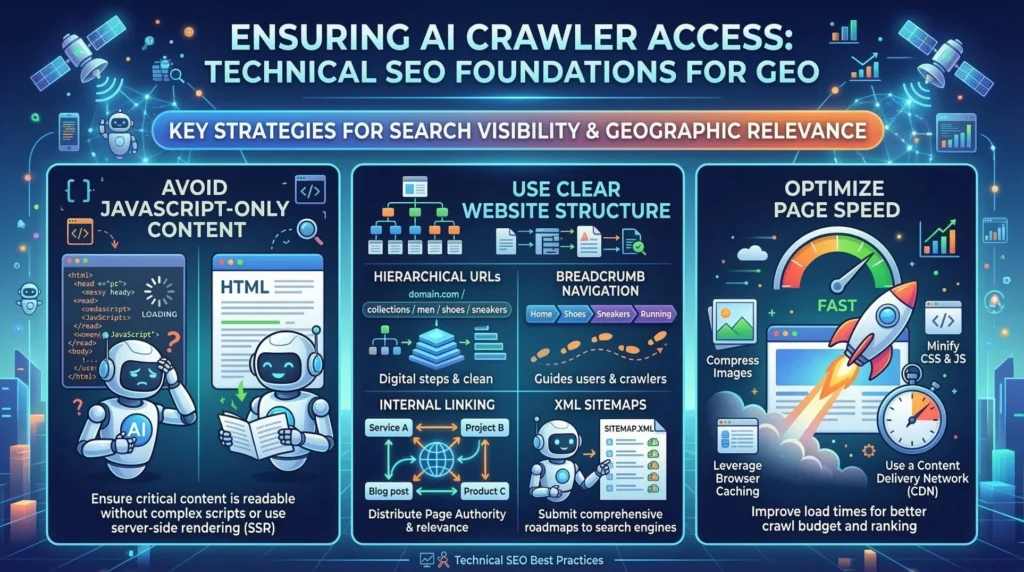
Avoid JavaScript-Only Content
Some AI crawlers struggle to render JavaScript-heavy websites.
If your content loads only after scripts execute, crawlers may not see it.
Best practices include:
- server-side rendering
- HTML content availability
- visible headings without scripts
This ensures all important information is accessible.
Use Clear Website Structure
Website structure helps AI understand relationships between pages.
A strong structure includes:
- hierarchical URLs
- breadcrumb navigation
- internal linking
- XML sitemaps
These signals help AI systems map your site more effectively.
Optimize Page Speed
Fast-loading websites benefit both users and search systems.
Page speed improves:
- crawling efficiency
- indexing frequency
- user experience
Performance optimization includes:
- compressed images
- minimal scripts
- reliable hosting
- caching strategies
Speed is a critical factor in modern SEO and GEO.
Content Optimization for Generative Engine Optimization
Content formatting is one of the most important factors in GEO success.
AI systems prefer information that is structured and easy to extract.
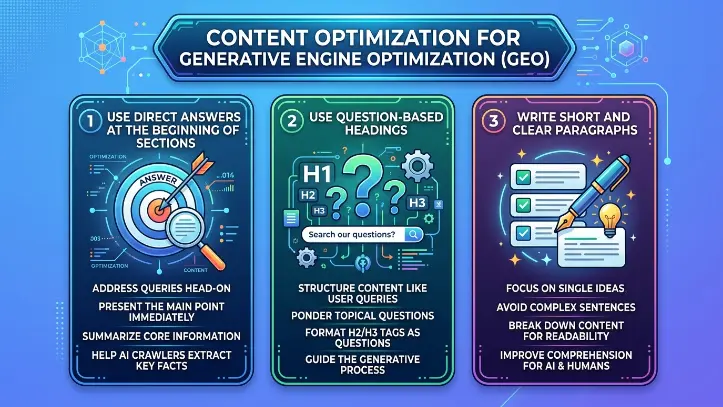
Use Direct Answers at the Beginning of Sections
AI engines often prioritize the first sentence of a section.
Start with a clear answer before expanding on details.
Example structure:
Answer → Explanation → Supporting information
This method increases the chances of your content appearing in AI responses.
Use Question-Based Headings
Most AI searches are phrased as questions.
Your headings should reflect that format.
Examples include:
- What is Generative Engine Optimization?
- How does AI search work?
- How can businesses optimize for AI search?
Question-based headings help match user intent.
Write Short and Clear Paragraphs
Short paragraphs improve readability and extraction.
Recommended structure:
2–3 sentences per paragraph.
Benefits include:
- faster reading
- easier scanning
- improved AI extraction
Avoid long blocks of text.
Use Lists and Tables
Structured formats make it easier for AI systems to extract information.
Example: Key Elements of GEO
- clear headings
- factual statements
- structured content
- schema markup
- internal linking
Tables are especially effective for comparisons.
Use Data and Specific Facts
AI models trust precise information.
Avoid vague language.
Instead of writing:
“many users find this helpful”
Use statements like:
“structured content improves extraction accuracy.”
Specific facts improve credibility and citation potential.
Use Schema Markup to Improve AI Understanding
Schema markup helps search engines interpret your content more clearly.
It provides structured data about your page.
FAQ Schema
FAQ schema connects questions with answers.
This format helps search systems quickly identify relevant information.
FAQ schema is particularly useful for:
- informational articles
- product pages
- service pages
This is how your Schema Markup looks like in order to Optimize Website for Gemini and ChatGPT Search.
<script type="application/ld+json">
{
  "@context": "https://schema.org",
  "@type": "FAQPage",
  "mainEntity": [
    {
      "@type": "Question",
      "name": "What is Generative Engine Optimization?",
      "acceptedAnswer": {
        "@type": "Answer",
        "text": "Generative Engine Optimization (GEO) is the process of optimizing website content to increase visibility in AI-powered search results and generative AI responses."
      }
    },
    {
      "@type": "Question",
      "name": "How does GEO differ from traditional SEO?",
      "acceptedAnswer": {
        "@type": "Answer",
        "text": "Unlike traditional SEO which focuses on keywords and backlinks for rankings, GEO prioritizes information density, direct answers, and structured data to help AI models cite your content."
      }
    }
  ]
}
</script>
HowTo Schema
HowTo schema structures step-by-step instructions.
It is ideal for tutorials and guides.
AI systems often use it when generating instructional answers.This is how your Schema Looks like to get into ChatGPT and Gemini and other AIs. You can just copy this and replace the site name by your ones.
<script type="application/ld+json">
{
  "@context": "https://schema.org",
  "@type": "HowTo",
  "name": "How to Optimize Website Content for GEO",
  "description": "A step-by-step guide to making your website content more visible to generative AI engines like Gemini and ChatGPT.",
  "totalTime": "PT30M",
  "estimatedCost": {
    "@type": "MonetaryAmount",
    "currency": "USD",
    "value": "0"
  },
  "supply": [
    {
      "@type": "HowToSupply",
      "name": "Target Keywords"
    }
  ],
  "tool": [
    {
      "@type": "HowToTool",
      "name": "Schema Generator"
    },
    {
      "@type": "HowToTool",
      "name": "WordPress Block Editor"
    }
  ],
  "step": [
    {
      "@type": "HowToStep",
      "url": "https://example.com/geo-guide#step1",
      "name": "Identify Question-Based Queries",
      "text": "Research the specific questions your audience is asking AI bots and document them as H2 or H3 headings.",
      "image": "https://example.com/images/step1.jpg"
    },
    {
      "@type": "HowToStep",
      "url": "https://example.com/geo-guide#step2",
      "name": "Write Direct Answers",
      "text": "Place a concise 50-word answer immediately following your question heading to help AI crawlers extract facts quickly.",
      "image": "https://example.com/images/step2.jpg"
    },
    {
      "@type": "HowToStep",
      "url": "https://example.com/geo-guide#step3",
      "name": "Implement Structured Data",
      "text": "Add JSON-LD HowTo or FAQ schema to the page to provide a machine-readable version of your instructions.",
      "image": "https://example.com/images/step3.jpg"
    }
  ]
}
</script>
Article Schema
Article schema identifies key information about content, including:
- author
- publication date
- article type
This helps establish credibility and freshness.
Dataset Schema
Dataset schema highlights original research and statistics.
AI systems often prioritize unique data sources.
If your website publishes research, dataset markup can improve visibility. If you are using WordPress or any Plugin You may miss Dataset schema there’s demo schema you can just copy and paste in order to optimize your website for chatGPT and Gemini seach.
<script type="application/ld+json">
{
  "@context": "https://schema.org",
  "@type": "Dataset",
  "name": "2026 B2B Digital Marketing Lead Trends in the USA",
  "description": "A comprehensive dataset covering lead generation trends, conversion rates, and SEO performance metrics for small-to-medium businesses in the United States.",
  "url": "https://yourwebsite.com/datasets/usa-lead-trends-2026",
  "keywords": ["Lead Generation", "SEO Trends 2026", "Digital Marketing Data", "GEO Performance"],
  "license": "https://creativecommons.org/licenses/by/4.0/",
  "isAccessibleForFree": true,
  "creator": {
    "@type": "Person",
    "name": "Your Name",
    "sameAs": "https://www.linkedin.com/in/yourprofile"
  },
  "distribution": [
    {
      "@type": "DataDownload",
      "encodingFormat": "text/csv",
      "contentUrl": "https://yourwebsite.com/downloads/lead-trends.csv"
    }
  ],
  "temporalCoverage": "2026-01-01/2026-12-31",
  "spatialCoverage": {
    "@type": "Place",
    "name": "United States"
  }
}
</script>
Building Topical Authority for GEO
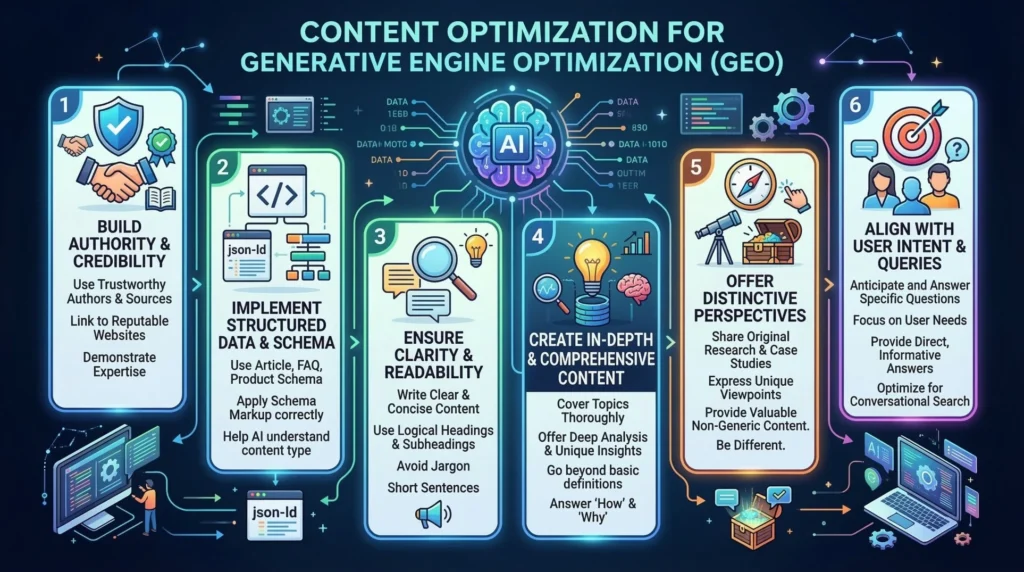
Authority signals are critical for AI citation.
AI systems prefer information from trusted sources.
Follow E-E-A-T Principles
E-E-A-T stands for:
- Experience
- Expertise
- Authoritativeness
- Trustworthiness
Ways to strengthen E-E-A-T include:
- expert author profiles
- transparent credentials
- high-quality content
- verified references
These signals improve trust signals for both search engines and AI systems.
Create Content Clusters
Content clusters help establish expertise around a topic.
A cluster consists of:
- one pillar page
- multiple supporting articles
Example cluster structure:
Pillar Topic: Generative Engine Optimization
Supporting articles:
- GEO vs traditional SEO
- AI search ranking factors
- AI-friendly content writing
- schema markup for AI search
Internal linking connects all related content.
This structure strengthens topical authority.
Maintain Brand Consistency
Consistent branding across the internet improves entity recognition.
Use the same brand description across:
- website pages
- social profiles
- guest articles
- press mentions
Consistency helps AI systems associate your brand with specific topics.
Use Digital PR to Build Authority
External mentions strengthen credibility.
Examples include:
- industry blogs
- media coverage
- professional communities
- guest posts
Frequent mentions increase your brand’s presence in online data sources.
Measuring GEO Success
Traditional SEO metrics are no longer enough.
New indicators help measure Generative Engine Optimization performance.
AI Citation Count
This metric measures how often AI systems reference your content.
Higher citation frequency indicates stronger authority.
AI Visibility Score
This measures your brand’s presence in AI-generated responses.
If multiple sources appear in an answer, your goal is to be one of them.
Conversion Quality
Traffic from AI recommendations often converts better.
Users arriving from AI responses usually trust the cited source.
This means higher quality leads.
The Future of Search
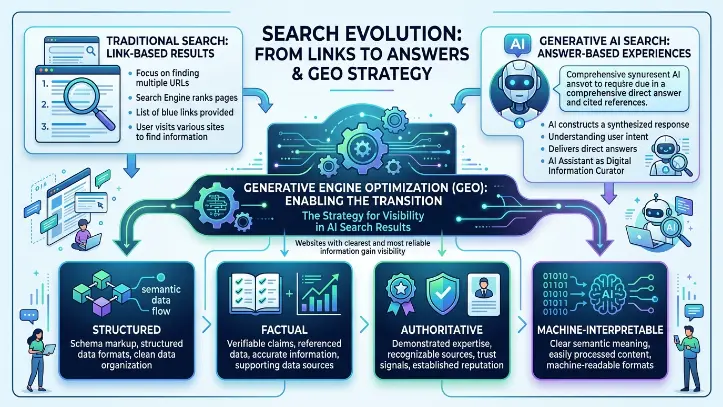
Search is shifting from link-based results to answer-based experiences.
AI assistants are becoming digital information curators.
Websites that provide the clearest and most reliable information will gain the most visibility.
The future of search belongs to content that is:
- structured
- factual
- authoritative
- easy for machines to interpret
Generative Engine Optimization is the strategy that enables this transition.
Conclusion
Generative Engine Optimization is rapidly becoming a critical component of modern SEO.
As AI search engines grow more powerful, websites must adapt their strategies to remain visible.
How to Optimize Website for Gemini and ChatGPT Search, the Successful GEO strategies focus on:
- strong technical SEO
- structured content formatting
- schema markup
- topical authority
- consistent branding
Websites that implement these practices will become trusted sources for AI systems.
In the evolving search landscape, the ultimate goal is no longer just ranking.
The goal is becoming the source that AI engines trust and cite.
FAQ: How to Optimize Website for Gemini and ChatGPT Search
What is Generative Engine Optimization?
Generative Engine Optimization is the process of optimizing website content so AI search engines can extract and cite it in their answers.
How is GEO different from SEO?
Traditional SEO focuses on ranking in search results, while GEO focuses on being referenced by AI-generated responses.
Why is GEO important for businesses?
GEO improves visibility in AI search tools, increases brand authority, and helps businesses stay competitive as search evolves.
How can websites optimize for AI search?
Websites should use structured headings, factual language, schema markup, and strong topical authority to improve AI visibility.
Leave a Reply